
UAE’s New Passenger Rail Means for Businesses and Trade
Published by TradBell | September 2026
The UAE is entering another important phase in its connectivity story.
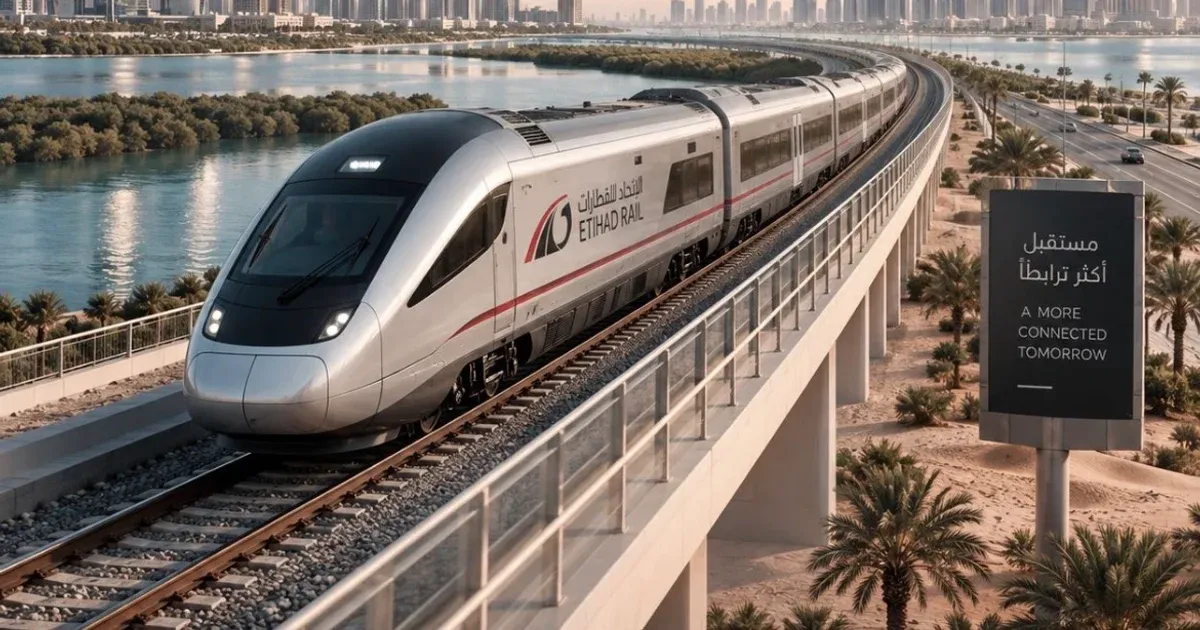
On 30 September 2026, passenger rail services are scheduled to extend to Dubai and Al Dhaid, following the launch of passenger services between Abu Dhabi and Fujairah on 30 June 2026. The Abu Dhabi–Fujairah journey takes approximately 1 hour and 45 minutes.
For many people, Etihad Rail may simply mean a new and convenient way to travel.
But from a business perspective, there is a bigger story.
Better connectivity can change how people work, how businesses access talent, how suppliers meet customers, and how commercial activity spreads across the UAE.
At TradBell, where we focus on connecting buyers and sellers in the UAE food-trading market, we see this development as part of a much larger transformation taking place across the country.
From Abu Dhabi–Fujairah to Dubai
The first passenger phase began on 30 June 2026, connecting Abu Dhabi and Fujairah. Etihad Rail has announced that Dubai and Al Dhaid will join the passenger network on 30 September 2026. Further expansion is planned through Al Dhafra, followed by Sharjah University City in March 2027.
Dubai’s new Al Yalayis Station is positioned in the southern part of the emirate, close to areas including Jumeirah Golf Estates, Al Furjan, Dubai Investment Park, Dubai Production City, Expo City Dubai and Dubai South. The initial Dubai–Abu Dhabi passenger journey is expected to take around 57 minutes.
This is more than another transport option.
It creates another layer of connectivity between residential communities, business districts and economic centres.
And that has implications for the way businesses operate.
⸻
The Workforce Effect: Talent May Become More Mobile
One of the most interesting consequences of improved transport infrastructure may not be the journey itself.
It may be where people choose to live and work.
Traditionally, employees often consider proximity to their workplace when deciding where to live. A long daily commute can make a job in another emirate less practical.
As rail connectivity improves, that equation can gradually change.
An employee living in one emirate may have greater flexibility to consider employment opportunities in another.
For employers, this potentially means access to a broader geographical talent pool.
For employees, opportunities outside their immediate city may become more accessible without automatically requiring a residential move.
This is particularly relevant to industries that depend on large and diverse workforces — logistics, hospitality, food distribution, retail, manufacturing, warehousing and services.
For the UAE’s rapidly developing economy, mobility of people can become an important part of mobility of opportunity.
⸻
What Does This Mean for UAE Food Traders?
This is where the development becomes especially interesting from TradBell’s perspective.
The food-trading business is not limited to one neighbourhood or even one emirate.
A typical B2B food supply chain can involve:
Importer → Cold Storage → Distributor → Wholesaler → Retailer → Restaurant → Consumer
And those businesses can be located across different parts of the UAE.
A buyer may be in Dubai.
A supplier may operate from Abu Dhabi.
A warehouse may be in another industrial area.
A customer may operate a restaurant or supermarket in Sharjah.
A trader may need to visit suppliers, meet customers, inspect products or build new commercial relationships.
Better connectivity makes the geography of business feel smaller.
That matters.
⸻
Connectivity Can Create More Business Opportunities
At TradBell, our core philosophy is simple:
We Connect. You Trade.
Our role is to help buyers and sellers discover each other.
But digital connectivity is only one part of the equation.
A successful physical trade relationship still depends on people.
People meet.
They inspect products.
They negotiate.
They build trust.
They visit warehouses.
They develop relationships.
They understand each other’s businesses.
Rail connectivity can complement this physical side of commerce by making movement between different parts of the country more accessible.
This does not mean every business meeting will suddenly happen by train.
Rather, it means the cost and friction of moving between business locations can gradually decrease.
And when friction decreases, new possibilities can emerge.
⸻
Dubai, Abu Dhabi, Sharjah and Fujairah: A More Connected Business Environment
The UAE’s strength has always been its ability to connect different economic centres.
Dubai is a major commercial and trading hub.
Abu Dhabi is a major economic and investment centre.
Sharjah has a significant industrial and commercial ecosystem.
Fujairah has strategic importance because of its location on the Gulf of Oman and its logistics and port-related activity.
Connecting these locations through a national passenger railway adds another layer to this economic network.
The benefit is not simply that someone can travel from Point A to Point B.
The bigger benefit is that business ecosystems become more interconnected.
A company can potentially recruit from a wider area.
A salesperson can potentially visit more customers.
A business owner can potentially attend meetings in another emirate more easily.
A worker may have more flexibility in choosing employment.
And entrepreneurs may think less about emirate boundaries when building their business networks.
⸻
Digital Trade + Physical Connectivity
There is another important point for the future of UAE commerce.
The future of B2B trade will not be purely physical or purely digital.
It will be a combination of both.
Platforms such as TradBell can help businesses discover products, suppliers and buyers digitally.
Transport infrastructure helps people move physically when relationships require it.
Together, these two layers can make a trading ecosystem more efficient.
Imagine a food buyer looking for a particular frozen product.
Today, the first step can happen digitally:
Search → Compare → Contact → Enquire
But the relationship may eventually move offline:
Meeting → Product inspection → Negotiation → Trial order → Long-term trade
Digital platforms reduce the difficulty of finding the right business.
Better transportation can reduce the difficulty of reaching that business.
That combination is powerful for a trading economy.
⸻
The Opportunity for SMEs and Traders
Large companies often have dedicated sales teams, logistics departments and established networks.
Small and medium-sized traders operate differently.
For an SME, a new customer can be extremely valuable.
A new supplier can open a new product category.
A new geographic market can create another revenue opportunity.
But SMEs also face a practical challenge:
Time.
Every unnecessary journey costs time.
Every difficult meeting costs time.
Every disconnected business relationship creates friction.
As the UAE’s transport network develops, businesses may gradually gain more flexibility in how they manage that time.
For the food-trading community, this could support greater interaction between wholesalers, distributors, importers, retailers, restaurants and other buyers.
⸻
But Connectivity Alone Does Not Create Trade
This is an important distinction.
A railway can connect cities.
A digital marketplace can connect businesses.
But trust creates trade.
At TradBell, we believe this is fundamental.
A buyer does not purchase simply because a supplier is geographically accessible.
The buyer wants confidence in:
* Product quality
* Availability
* Pricing
* Specifications
* Origin
* Delivery capability
* Communication
* Business reliability
Connectivity makes access easier.
Trust makes transactions possible.
That is why the next stage of UAE B2B commerce is not simply about moving faster.
It is about making it easier for the right buyers and the right sellers to find each other and build reliable relationships.
⸻
A Smaller UAE for Business
There is a broader idea behind Etihad Rail that interests us at TradBell.
Infrastructure can change the perceived size of a market.
When travelling between cities becomes easier, businesses may begin thinking beyond their immediate surroundings.
A Dubai trader may look more actively toward Abu Dhabi.
An Abu Dhabi business may explore customers in Dubai.
A supplier in one emirate may find opportunities in another.
Workers may consider jobs outside their immediate residential area.
And businesses may build networks that span the entire UAE rather than one city.
Over time, this can contribute to a more interconnected domestic marketplace.
⸻
What We See at TradBell
TradBell is built around a very simple observation:
The UAE has thousands of businesses trading food every day, but finding the right buyer or supplier is not always easy.
The opportunity is to make that discovery easier.
Etihad Rail represents a different but complementary part of the same broader story.
Digital infrastructure connects businesses.
Physical infrastructure connects people.
Trust connects transactions.
When all three improve together, the business environment can become more accessible.
For the UAE food-trading sector, this could mean more opportunities to build relationships across emirates, reach new customers and suppliers, and develop stronger domestic trade networks.
⸻
The Next Chapter of UAE Connectivity
The launch of passenger rail between Abu Dhabi and Fujairah was an important beginning.
The arrival of passenger services in Dubai and Al Dhaid on 30 September 2026 marks another major stage in the rollout. Further stations are scheduled to follow through the end of 2026 and into 2027.
Etihad Rail reported that more than 70,000 passenger tickets had been sold by August 2026, with customers booking an average of 12 days in advance — an early indication that people were beginning to incorporate rail into their travel planning.
The long-term impact will not be measured only by the number of passengers.
It will also be seen in the connections created around those journeys.
People connecting with jobs.
Businesses connecting with talent.
Customers connecting with suppliers.
Cities connecting with economic opportunities.
And traders connecting with new markets.
At TradBell, we believe that is where the real opportunity lies.
Better connectivity doesn’t just help people move.
It helps opportunities move.
And as the UAE becomes increasingly connected, the country’s businesses — particularly its thousands of SMEs, traders, distributors and food businesses — have the opportunity to become more connected with one another.
TradBell — We Connect. You Trade.
⸻
Suggested SEO setup for TradBell
SEO Title:
Etihad Rail UAE: What Better Connectivity Means for Businesses and Food Traders
Meta Description:
Etihad Rail is expanding passenger connectivity across the UAE. TradBell explores what better rail connectivity could mean for workers, SMEs, food traders, suppliers and B2B commerce.
Suggested URL:
/blog/etihad-rail-uae-business-connectivity-food-trade
Primary keywords:
* Etihad Rail UAE
* Etihad Rail Dubai
* UAE business connectivity
* UAE food trading
* Dubai Abu Dhabi rail
* UAE B2B trade
* UAE food suppliers
* UAE wholesale market
* UAE business network
* Etihad Rail business impact