
The UAE has built one of the world's most……..
Iran Attacks UAE After 26 Days of Ceasefire: What Happened, Why Tensions Escalated
Iran's attacks on the UAE on May 4 have effectively shattered a fragile US-Iran ceasefire, triggering regional escalation, civilian injuries and global economic ripples.
A fragile ceasefire between the US and Iran was called into question on Monday, May 4, after Iran launched fresh attacks on the UAE. The long-awaited deal was brokered on April 8 — 40 days after the US, Israel and Iran traded fire in what they described as preemptive and retaliatory aerial strikes. World leaders have since condemned the severe escalation, which occurred during a week both sides had ramped up their war rhetoric despite ongoing peace negotiations.
What Happened on May 4? How Did the Attacks Start?
At 4:59pm on Monday, residents across the UAE received an emergency alert warning of a potential missile threat, urging them to remain indoors or move to safe locations. The alerts were the first in 26 days since a ceasefire had been declared on April 8 and came as a stark reminder of the fragility of the truce. Authorities issued at least five alerts over 3.5 hours, guiding residents on when to seek shelter and when the situation was safe.
How Many Missiles and Drones Were Launched?
During the initial wave, four cruise missiles were detected heading toward the country — three were successfully intercepted, while the fourth fell into the sea. The UAE later confirmed its air defence systems engaged a total of 12 ballistic missiles, three cruise missiles, and four drones launched from Iran on May 4.
Since the beginning of Iran's aggression on February 28, the cumulative total stands at approximately 549 ballistic missiles, 29 cruise missiles, and 2,260 UAVs or drones — nearly 3,000 attempts, the vast majority of which were successfully intercepted by UAE air defences.
What Happened in Fujairah?
Iranian drones targeted Fujairah's Petroleum Industries Zone, triggering a fire at the site. Officials confirmed three Indian nationals sustained moderate injuries as a result and were taken to hospital for treatment. Emergency response teams secured the area and managed the aftermath of the strike.
Why Did Iran Attack?
Tensions had been building in the days prior, with both sides exchanging warnings and accusations. On May 3, US President Donald Trump announced 'Operation Project Freedom' — a military-backed initiative to guide and escort stranded commercial vessels through the Strait of Hormuz, which Iran had effectively restricted. Iran strongly opposed the move, calling it a violation of its sovereignty. An unnamed Iranian military official cited by state TV described Monday's aggression as a direct consequence of what they called "illegal ship transit" by the US.
Were Ships Attacked?
The British maritime security agency UKMTO reported two vessels were hit off the UAE coast. Emirati energy company Adnoc also confirmed one of its empty oil tankers was struck by Iranian drones in the Strait of Hormuz.
"These attacks are unacceptable and a direct threat to the UAE's security, stability, and territorial integrity. The UAE reserves the full right to respond in line with international law."
— UAE Government statement, May 4, 2026
Has the Ceasefire Broken?
One of the core conditions of the ceasefire deal was a full cessation of hostilities. Monday's attacks were an effective violation of that truce. While world leaders stopped short of explicitly declaring the ceasefire broken, condemnation was unanimous. The US military also reported its Apache and Seahawk helicopters struck six Iranian boats that were threatening commercial shipping, after President Trump ordered the Navy to escort stranded tankers under 'Project Freedom'. Iran views the US escort operation as itself a ceasefire breach.
On Tuesday, US Defence Secretary Pete Hegseth clarified that "the ceasefire is not over" and that the Strait of Hormuz protection operation is temporary. Since Monday night, no further escalations were reported, suggesting a fragile — if contested — stabilisation.
Impact on Flights, Schools and Markets
UAE aviation authorities reported no disruption to air traffic operations. However, Indian airline IndiGo issued travel advisories, and flight tracking data showed some UAE-bound aircraft were diverted to Muscat or held in a holding pattern over Saudi Arabia.
Schools, universities and nurseries across the UAE shifted back to distance learning until Friday, May 8, as a precautionary measure — just weeks after students had returned to in-person learning on April 20 following nearly seven weeks of remote education.
On the markets front, Asian stocks fell as Middle East tensions reignited fears over the ceasefire. Gold prices edged higher, while the Indian rupee slid to a record low, breaching 95 against the US dollar and approaching 26 against the UAE dirham.
How Did Leaders React?
The UAE condemned the strikes as unprovoked and warned it will not tolerate any threat to its sovereignty. Senior Emirati diplomat Dr Anwar Gargash called Iran's escalation "a moral bankruptcy for a regime that has chosen aggression as its approach to dealing with its neighbours."
Indian Prime Minister Narendra Modi condemned the attack in Fujairah, calling the targeting of civilians and infrastructure "unacceptable," and expressed firm solidarity with the UAE. Modi also stressed the importance of ensuring safe navigation through the Strait of Hormuz for regional peace and global energy security.
President Trump warned Iranian forces they would be "blown off the face of the Earth" if they targeted US ships. The EU, Germany, France, the UK, Saudi Arabia and several GCC nations all called on Tehran to return to the negotiating table.
Post-attacks, Iran's Foreign Minister Abbas Araqchi urged a return to peace talks, saying there is "no military solution" to the crisis and that peace negotiations were progressing with Pakistan's mediation.
TradBell View: UAE Food Trade Resilience in the Face of Regional Uncertainty
At TradBell, we operate at the heart of the UAE's wholesale food trading ecosystem — connecting suppliers, importers and buyers across the Emirates daily. Events like those of May 4 naturally raise questions from our trade community: What does this mean for food supply chains? Are imports and cargo movements affected? How should traders plan?
The answer, grounded in the UAE's extraordinary track record, is one of confidence.
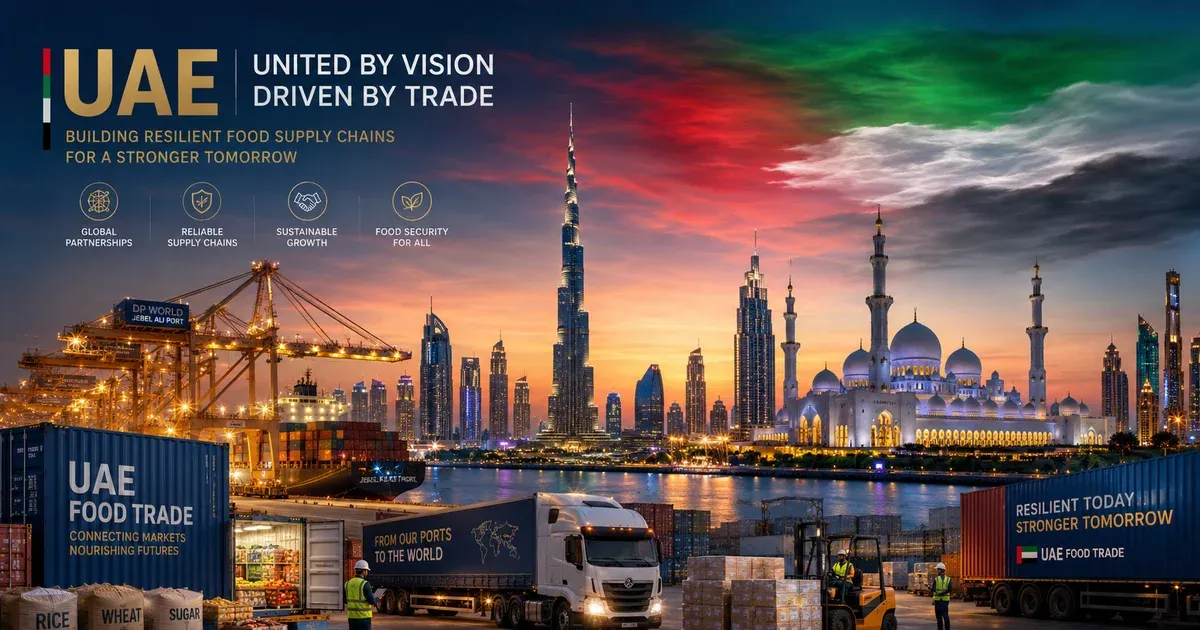
The UAE has built one of the world's most robust food security infrastructures precisely for moments like this. Strategic food reserves, diversified import corridors, and a government that treats food security as a national priority mean that disruptions at the Strait — even serious ones — do not translate into empty shelves or supply chain collapse for UAE traders.
The UAE's air defence systems intercepted the overwhelming majority of Monday's attacks. The country's leadership responded swiftly, its institutions held firm, and normal commercial activity continued across most of the nation. This is the UAE that trade partners around the world have come to rely on — a nation that does not flinch.
For wholesale food traders, our read is straightforward:
Short-term freight costs on Gulf shipping lanes may see temporary upward pressure, and importers relying on Strait of Hormuz sea lanes should monitor cargo advisories closely. However, the UAE's well-established alternative logistics routes — through Jebel Ali and other ports with land-side contingency options — provide meaningful buffers. The government's proactive reserve management further cushions any transient supply disruption.
Demand for staple food commodities in the UAE remains strong and stable. If anything, periods of regional uncertainty historically drive bulk-buying behaviour among buyers, accelerating wholesale trade activity on platforms like TradBell as businesses look to secure forward stock at current prices.
TradBell's marketplace continues to operate normally. Our members — traders, importers and suppliers across Dubai, Abu Dhabi, Sharjah and the wider GCC — are active, listing products and connecting via WhatsApp inquiries as usual. Trade does not stop; the UAE does not stop.
We stand with the UAE, its leadership and all residents navigating this difficult moment. The resilience of this nation — its people, its institutions and its economy — is precisely why the UAE remains the most trusted food trade hub in the region.
If you are a food trader, importer or supplier looking to connect with verified buyers and sellers across the UAE and GCC, TradBell is here — open, active and ready to support your business.
Explore Live Listings on TradBell → ```